Tuesday, January 25, 2011

Tuesday, January 25, 2011

1/25/11

Announcements - The first of quiz in this unit will be his Thursday.

Today In Class - Today in class we started by picking up some new pages for our notebooks. We then went over the lab from yesterday that was supposed to be finished for today. Mr. Paek went over some of the problems and also made sure that everyone knew what they were doing. Once we finished going over the lab, Mr. Paek showed us how to find the molecular mass of a compound. For example, the compound NH4Cl . The name of this compound is ammonium chloride. To find molecular mass of a compound, you start by finding the atomic mass of each element. In ammonium chloride, N has 14. H is one, but since there are four H's, you would really have four H. There are also 35.5 Cl. After you have found all of this, you add it all together. Once you have added it all together, you will end up with 53.5 g/mol. After we were showed molecular mass, we went over conversions one more time.

Homework - The homework for today is every problem on both page one and page two. On page three, you only have to do problem one both a and b, and problem two both a and b. On page four, you have to do all of problem three, four, and five. On page five you have to do problem one, letters e, f, g, h. The last page you have problems to do for homework is page six. You have to do problem two, letters d, e, f, and g.

THE NEXT SCRIBER WILL BE.................... yassine

Monday, January 24, 2011

1/24/11

Announcements- There will be 6-7 quizzes this unit. If you get 5-6 perfect scores then you will get some extra points added to your quiz category. Also, in order to take the final test, you must have a perfect score on at least 1 quiz you take. If you fail to do so, Mr. Paek will not let you take it with the class until you do.

Today In Class- Today in class, after rejoining us to the class again and welcoming any new students, we were introduced to the mol. A mol is 6.02 x 10 to the 23rd power. We were also told that a pair=2 and a dozen=12. Then we did a lab that worked on using Unit Analysis for finding the number of atoms in a certain number of grams, the number of grams in a certain number of mols, and the number of mols in a certain number of grams. An example of a question for finding the number of grams would be: How many grams would 3.01 x 10²³ atoms of Al (26.98 grams) be? 3.o1 x 1023 atoms x 26.98 g
6.02 x 10²³ atoms
Then you would cancel out atoms and do the math.

Homework- Finish the lab. We're going over it in class if you have any questions.

THE NEXT SCRIBER WILL BE....... paul mcmahon

Thursday, January 20, 2011

Hi everybody! :D I just realized that I can still log on to moodle which makes me quite happy so I thought I stop by and say hi :)

Sunday, December 12, 2010

10-12-2010

Announcements:
We will be having our second quiz next week, test on Thursday, and a party on Friday

Today we did a single replacement reactoins lab. We had four substances: Mg(NO3)2, Cu(NO3)2, Zn(CO3)2, and Ag(NO3)2. We also had three metals: Zinc, Magnesium, and Copper. We tested all three metals reactions in all four substances. Our goal was to put in order the most reactive metal to the least reactive metal. In addition, we know that all chemical reactions between the metals and substances were to be considered single replacement reactions were one element takes another's place. We made a data table to find the most reactive. We found four single replacement chemical reactions and we solved and balanced their outcomes:
Zn+Cu(NO3)2=Zn(NO3)2+Cu
Zn+Ag(NO3)2=Zn(NO3)2+Ag
Mg+Cu(NO3)2=Mg(NO3)2+Cu
Mg+Ag(NO3)2=Mg(NO3)2=Ag
Then we concluded that Magnesium was more reactive than Zinc because it had more violent reactions with the substances. So the order was Magnesium, Zinc, and Copper.

Peteri
Chemical Reactions
Scribepost
Chem2010-2011

Wednesday, December 8, 2010

12/8/10

Announcements
  • Quiz tomorrow on balancing
  • Possibly a quiz on Friday so be ready
  • Test on the last Thursday before break

What We Did In Class

Today in class we first went over the homework we had the night before, which was pages 8 and 9. If you didn't do it, you probably should. It's good practice. We asked questions about it in class and got many questions cleared up. We then basically reviewed of what we learned yesterday, and elaborated more on each subject. We went over single replacement (p. 13), double replacement (p. 14), Decompostion (p. 15), synthesis (p. 16 &17), and Combustion (p. 17).

Before I describe anything we did today for you, I want you to know 1 trick that is needed every time this happens. Whenever the elements Hydrogen, Oxygen, Nitrogen, Chlorine, Bromine, Iodine, and Florine appears alone in an equation, always put a 2 after it. This is how it is used in nature so it is needed in the writing part too. A way to remember this is HONClBrIF and sound it out.

When going over single replacement, you need to find out which elements are positive or negative ions. If there are 2 positives and 1 negative, then you switch the negative from the one positive to the other. And then of course, balance it out. For example, if you had the formula: ZnS+ O2--->_____. Zn is positive, S is negative, and O is negative. So therefore, on the other side, it would be ZnO2 +S. But then you would have to balance it. So on the right side it would be 2ZnO because on the left it says there are 2 atoms of O (O2). And since I had to change that on the right, on the left it would be 2ZnS, which means on the right I would change it to 2S.

For double replacement, you do the exact same thing as single, except there will be 2 positive ions and 2 negative ions. So you would just swap them and balance them out again.

When doing decomposition, one compound splits up into 2 different ones. For example AB---> A + B. When using elements, an example would be HgO---> Hg + O2. or MgCl2---> Mg + Cl2. Make sure to balance them at the end.

Synthesis is the exact opposite of decomposition. Just put them back together. A + B---> AB. An example using elements would be K + Cl2---> KCl. Mg + O2---> MgO. Make sure that they're balanced at the end.

Finally, we have combustion. This is when there is a carbon atom, hydrogen atom, and oxygen atom all in the same equation. The answer for every single one would be CO2 + H2O no matter what. But the hard part about this is balancing them out. The easiest and smartest way to do this is by using the CHO rules. This is the order of balancing out the equation. Carbon, Hydrogen, and Oxygen. CHO. You won't forget.

Homework:

Page 10 in your journal

-------------------------------------------------------------------------------------------------

THE NEXT SCRIBER WILL BE........... VIT

Tuesday, December 7, 2010

Announcements

Chem thinks tomorrow.

HomeWork

NONE

Body

In class today we started our new unit that has to do with Atom counting and balancing atomic equations. First is Atomic counting, it is something that we did in the begging of the year if you have an equation with 2c + 2H2 you draw two seperate C's and draw two H's together and have two of those. We also learned atomic counting, a couple examples of this are
1. 3 N2O + N2 N: 8 O: 3
2. 5 Ca(NO3)2 + 2 O2 Ca: 5 N: 10 O: 34
3. 5 C3H8O + 3 CO2 C:18 H:40 O: 11
The first number tells you how many molecules there are, the next number tells you how many of that type of atom are in that molecule. So you do the math from there.
The last thing we learned is balancing atomic equations. For example: 4 Li + 02-------2 Li20, you first find how much of each atom is in the both sides of the equation to see if there even, so in the equation above, there is 4 Li on the left side and 4 on the right, there is 2 O on the left and 2 O on the right, so this equation is right already you just have to show how you counted them. There are equations where you must show work: example: Al + Pb(NO3)2----- Al(NO3)3 + Pb, so your first step is to see how many Al are on each side, which they are equal.. so then you take the next atom which is Pb, that is equal.. so then you take the next atom which is NO3 and they are not the same, so you have to multiply the right side by 2 and the left by three, which makes it uneven again because the left side has 3Pb now so you have to multiply the left sides Pb by 3, and it is still uneven because the right side had 2 Al so you have to multiply the left sides Al by 2.. so your final equation is... 2Al + 3Pb(NO3)3----- 2Al(NO3)3 + 3Pb. And that is how you do balancing... you can do extra work on pg. 8 and 9

the next scriber will be..... Robert Maxwell Cohen.

Monday, November 22, 2010

11/22/2010

Announcements- Lab Test tomorrow.

Homework- Do the analysis questions from today's lab. Look over your labs to study for the test.

In class today we did the Polarity Olympics lab.


-Part one- Solubility.


In this part of the lab, we want to see if hexane, ethanol, pentanol, methanol, butanol, and acetone mix with water.
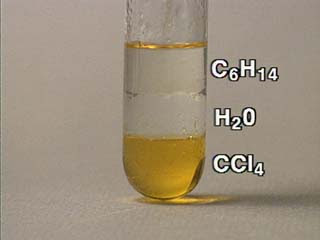
~This is what it looks like if it does not mix with water. There is a split between the different solutions.
After we do this, We see if it mixes immediately. If it does not mix we have to put a stopper on the test tube, shake it, and then see if it mixes then.
-Hexane- Does not mix immediately, Does not mix after shaking.
-Ethanol- mixes immediately, It stays mixed after shaking.
-Pentanol- Does not mix immediately, Does mix after shaking.
-Methanol- Does not mix immediately, Does mix after shaking.
-Butanol- Does not mix immediately, Does mix after shaking.
-Acetone- mixes immediately, Stays mixed after shaking.
-Part two- Volatility and Surface Tension
In this part of the lab we want to see which solution spreads faster and which solution evaporates the fastest. What we do is we put a drop of each liquid on the lab table and see which one spreads more and which one evaporates faster. 7th being spreads out the least and evaporates the slowest.
Liquid Spreading rank Evaporating rank
-water 7 7
-hexane 1 2
-ethanol 5 4
-pentanol 6 3
-methanol 4 5
-butanol 3 6
-acetone 2 1
The liquids that spread out more are non polar and the liquids that spread out the least are polar because the atrraction is has on the solution gets the solution closer together and holds it together more. Also if something is more polar, then it will evaporate the slowest because sticks more together to the table. That is why hexane evaporates faster, it is because it is non polar and there is no attraction to it that holds it down and together.
The next scriber will be Mahak =]