Showing posts with label p2chem2010. Show all posts

Wednesday, March 16, 2011

3.15.11


Announcements: Our test for this new section will either be on Friday the 25th, or Thursday the 24th depending on which day we have a Chem day. Mr. Paek also informed us that we only have 2 more major sections and then we're home free, which is extremely exciting.

In Class: Today in class we did the Heating Curve Lab:
Items Needed: Beaker filled 1/2- 2/3 way with ice, hot plate/burner, thermometer in Celcius.
Procedure: We took a beaker filled with ice cubes and put it on a hot plate/burner. We then every 30 seconds wrote down the temperature of the water at the time. After the ice had melted you were still supposed to write the temperature, up until 3 minutes after the water had started to boil. When you're done with this, you need to make sure that you write down the temperatures and times. Then you needed to answer the usual questions on the sheet and make a graph with the time on the X-Axis and the temperature Y-Axis. (Reminder: Have a title for your graph, and name the x and y axis. Mr. Paek said he'd be grading these for accuracy)


Homework: Finish the graph and answer the questions!

Monday, November 22, 2010

11/22/2010

Announcements- Lab Test tomorrow.

Homework- Do the analysis questions from today's lab. Look over your labs to study for the test.

In class today we did the Polarity Olympics lab.


-Part one- Solubility.


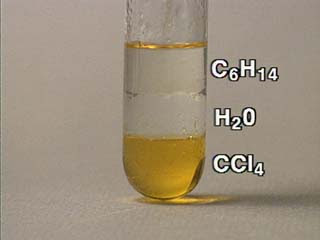
In this part of the lab, we want to see if hexane, ethanol, pentanol, methanol, butanol, and acetone mix with water.
~This is what it looks like if it does not mix with water. There is a split between the different solutions.
After we do this, We see if it mixes immediately. If it does not mix we have to put a stopper on the test tube, shake it, and then see if it mixes then.
-Hexane- Does not mix immediately, Does not mix after shaking.
-Ethanol- mixes immediately, It stays mixed after shaking.
-Pentanol- Does not mix immediately, Does mix after shaking.
-Methanol- Does not mix immediately, Does mix after shaking.
-Butanol- Does not mix immediately, Does mix after shaking.
-Acetone- mixes immediately, Stays mixed after shaking.
-Part two- Volatility and Surface Tension
In this part of the lab we want to see which solution spreads faster and which solution evaporates the fastest. What we do is we put a drop of each liquid on the lab table and see which one spreads more and which one evaporates faster. 7th being spreads out the least and evaporates the slowest.
Liquid Spreading rank Evaporating rank
-water 7 7
-hexane 1 2
-ethanol 5 4
-pentanol 6 3
-methanol 4 5
-butanol 3 6
-acetone 2 1
The liquids that spread out more are non polar and the liquids that spread out the least are polar because the atrraction is has on the solution gets the solution closer together and holds it together more. Also if something is more polar, then it will evaporate the slowest because sticks more together to the table. That is why hexane evaporates faster, it is because it is non polar and there is no attraction to it that holds it down and together.
The next scriber will be Mahak =]

Thursday, November 18, 2010

11/18/10

Announcements: Chem day tomorrow 11/19/10 in the lyceum
Quiz on Monday
Lab test on Tuesday
Homework: None

In the beginning of class we learned about polar and non-polar molecules. Polar molecules can not be split while non-polar can. If the molecule is bent it will always be polar. Just because it has polar bond does not mean it is a polar molecule.

The Lab: In the lab we put drops of water and hexane on a penny. The penny was able to hold more drops of water than hexane because it is a polar molecule. Polar molecules like to clump together because of the opposite charges within itself attract each other.


We also put drops of water and hexane in a watch glass and then put a thin glass tube (called a capillary tube) upright and covered the top of the tube so the liquids would go up the tube. The water went up further and stayed in the same spot when we tipped the tube back and forth. While the hexane didn't go up as far and would move around when tilted. Since the water molecule stayed in the same spot, the glass molecules are polar. This is because it attracted the water which is polar and did not attract the hexane because it it non-polar and likes attract likes.

In the last part of the lab we drew two lines on a watch glass. One of the lines was with a transparency marker and the other with a permanent marker. When we use the cotton swab with water on it the transparency line came off and the color leaked onto the swab. It also cleaned up all of the permanent line. Then we drew two more lines on a watch glass and put hexane on a different cotton swab. When we wiped the transparency line it did not come off and the line stayed on the watch glass. When we wiped the swab on the permanent line it came off. The ink in transparency marker is polar because the water(polar) was able to be wipe up while the hexane(non-polar) was not able to pick up the transparency line.

The next scriber will be Elizabeth.

Tuesday, November 16, 2010

11.16.10

ANNOUNCEMENTS: We took a quiz today, pick up pages 21-24 if you were not here, and I think that is it.


HOMEWORK: Page 24


Today we learned about different types of bonds that are related to electronegativity. Electronegativity as you may remember, describes an element's tendency to "hog" electrons (pull them closer to themselves than the other atom). We got a periodic table that has each element's electronegativity.


The three different bonds we learned were:


Purely covalent/non-polar: In this bond, neither atom has that much of a stronger pull than the other. The difference between the electronegativites of the two atoms will be 0.0-0.4


(*To find the electronegativity difference just subtract the smaller electronegativity from the larger one. EX: Carbon has an electroneg. of 2.5, Hydgrogen has an electroneg. of 2.1 so the difference is .4 This would be a non-polar covalent bond.)


Polar covalent: One atom has a slightly larger electroneg. causing it to have a stronger attraction to more electrons. Difference of electroneg. is 0.5-1.6


(EX: Hydrogen is 2.1, Oxygen is 3.5. The difference is 1.4 so it is polar covalent.)


In both of these, electrons are shared.


Ionic: In an ionic bond, one atom has a significantly larger attraction to the electrons than the other. In this case electrons are transferred. The range for this is 1.7 or greater.


(EX: Sodium is .9 and Flourine is 4.0 The difference is 3.1 so it is ionic)


We also learned how to identify atoms with a partial positive and a partial negative charge.


The atom with the greater electronegativity will have a partial negative charge because there are more electrons going towards it. And the partial positive atom has the smaller electronegativity because there are less electrons attracted to it.


Mr. Paek taught us the symbol that is used for this.


Disregard the second picture, he did not teach us that. The S looking thing is the symbol. If it's partial negative then a - sign will follow the symbol. And if its partial positive then it will be a + sign. In this image, hydrogen has an electronegativity of 2.1 and flourine has one of 4.0 Because flourine's electroneg. is greater, more electrons are attracted to it so it has a partial negative charge.
That's all folks!
Oh and the next scriber shall be Jillian (:

Monday, November 15, 2010

Monday, November15, 2010

11/15/2010
Announcements:
-Test will be on Wednesday after thanksgiving break.
-Web assigns are due Tuesday after thanksgiving break.
-Mr. Paek said he will not return our quizzes, but we get to retake one and drop the lowest.
-Mr. Paek also said that if there is anyone who doesn't get the lewis structure, they should go see him ASAP because it's important. The lewis structure is a key concept and you have to completely get it in order to understand upcoming lessons.
Homework:
-Finish up to page 19.
- Make sure you finish the 2 practice sheets we got on Thursday that go along with the chem think.(they might be collected tomorrow.)
In Class:
Well first Mr. Paek introduced to us the concept of VSEPR. He said that he will use this term a lot and he wants us to understand it. here is what each letter stand for:
-V= Valence
-S= Shell
-E= Electron
-P= Pair
-R= Repulsion
-This theory is used to prove that electron want to repel as far away from each other as possible.
-there are 5 types of molecular shapes: linear, bent, trigonal planar, trigonal pyramid, tetrahedral.
*Linear and bent are usually associated with 2 electrons and are are usually 2 dimensioned . (example by Mr. paek: If Mac and Kevin were to have a fight where would they go in the room to be as far away from each other as possible? the answer was in the corners of the room.)
*Trigonal planar, trigonal pyramid, and tetrahedral are associated with 3 electrons and are usually 3 dimensioned.(example by Mr. paek: if Max, Kevin, and Jimmy were to fight over kinga, where would they want to be in the room in order to be as far away from each other as possible? the answer was 2 would be in each corner and one would be in the middle)
- those were examples to help us visualize and help us understand what molecular shapes look like.
-Other key things to remember is that the lone pairs are key because they push everything down and change shape. And for shape you don't need dots unlike lewis structure.
- The picture at the right is page 16: I am going to go over the first one, so you guys get an idea on what we did today.
CS2
Needs: 24; Has:16;Shares:8; Bonds:4 .

I am sure we all know how to draw the lewis structure for this one ( see Mr. Paek if you don't), well the molecular shape is the same as the lewis structure but without the dots. and the name of the shape is linear.
The next scriber will be Andrea.

Wednesday, November 3, 2010

10.4.10


Handouts:
·         Practice Conversions – due next Monday (only if asked by Mr. Pak but should be done anyway)
·         Periodic Table
Homework:
·         Two ChemThinks – due Wednesday
    
   - Atomic Structure
   - Isotope (take notes)
In Class:
·         We were given two pages to tape into our notebooks

-Electron Configuration 1 pg.6
-Electron Configuration 1 pg.7

·         We were given practice conversion sheets which if told that you needed to do them, they are due Monday.
·         Took notes from power point on Quantum Theory (see below for notes)
·         Went to the computer lab to work on the ChemThink’s.
Power Point Notes:
        Page 1-
              Quantum Theory
o   Where are the electrons?
o   Orbitals are predictions of electron location

Page 2-
       First Quantum # -n energy levels
o   1-7
o   Describes the energy
o   The larger, then more energy and usually further from the nucleus
Picture below is of electrons placed in definite orbitals (called shells) around the nucleus.

http://www.clickandlearn.org/Gr9_Sci/atoms/ruther.gif

TESTS:

·        Test - October 8th
·         Lab Test - October 11th

Monday, November 1, 2010

Oct 29, 2010

Polyatomic Ions
In class today we learned about naming and writing formulas for ionic compounds. The chart below shows some Polyatomic Ions.

  • You have to treat these as One Thing.
    Ex) write the formula for elements:

Follow steps for naming and writing formulas for ionic compounds.


1)Find the name of each element


2)Write metal first

  • If the first elements are in the transition column; Sn, Pb and D-block elements; then, you use roman numerals in the name of an ionic compound.
    Ex)

3) Write non-metal next

  • For step 3, the non-metal ends with – ide.
    Ex) carbon→carbide


  • When you have a polyatomic ion you write the given names of them.
    Ex) CaCO → calcium carbonate


Upcoming event!

We have Quizzes on Monday through Wednesday! Prepare for these quizzes!.


Wednesday, October 6, 2010

October 6, 2010

Electron Configuration
In class today we learned more about how to find the electron configuration of a nuetral atom. The point of electron configuration is to find the location of the electron.

Shapes of Orbitals
There are four different shapes of orbitals
1) S-one orientation-holds 2 electrons
2)P-three orientations-holds 6 electrons
3)D-five orientations-holds 10 electrons
4)F-seven orientations-holds 14 electrons


The S block always starts as 1S
The P block always starts with 2P
The D block always starts with 3D
The F block always starts with 4F

EXAMPLE 1:
If the electron configuration of a neutral atom is 1s2 2s2 2p6 3s2 3p6 then....
a)How many electrons does it have?
18 electrons
(there are two ways in how to find this)
  1. Add all of the second numbers together (2+2+6+2+6)
  2. Look at the last electron configuration, which is 3p6, and find it on your periodic table.
b)How many protons does this atom have?
18 protons
(Since this is a neutral atom, the electrons and the protons are the same amount)

c)Write the symbol for this atom
Ar
(You can find this on your periodic table)

EXAMPLE 2: Lets say you need to write the electron configuration of Bi (Bismuth). You have to start with 1s2 and end with 6p3(which is where bismuth is located) The way to find write the in between atoms is to read the periodic table from left to right.
1s2 2s2 2p6 3s2 3p6 4s2 3d10 4p6 5s2 4d10 5p6 6s2 4f14 5d10 6p2.

Orbital Diagram

Each half arrow represents how many atoms are in that row.
ALWAYS PUT ONE HALF ARROW FIRST IN EACH BOX BEFORE PUTTING THE SECOND HALF ARROW IN IT.

Ionic Electron Configuration

To write the ionic electron configuration is same as usual. Except for example if they want you to write the electron configuration of O-2, then you have to find where O is, which is 2p4, and go forward 2 because you are gaining 2 more electrons, which is 2p6 and is the atom Ne (Neon)

IN CLASS
We did pages 6, 7 and some of 11 of electron configuration.

REMINDERS
Webassigns are due on Friday. Test is on Friday.

HOMEWORK
Page 8 of electron configuration.

Sunday, October 3, 2010

October 1, 2010

ATOMIC STRUCTURE: In class on Friday we defined a few terms that have to do with atoms.

Proton- It has a positive charge and its location is in the nucleus (Remember Proton is Positive)

Neutron- Neutral, it has no charge. Its location is in the nucleus as well.

Electron- Located outside the nucleus. They have a negative charge


We also learned some stuff that has to do with the PERIODIC TABLE.

-The number located above the element's symbol is the atomic number. It represents the number of protons


-The number below the symbol is the atomic mass. That stands for the number of protons PLUS the number of neutrons.


*An atom will usually have the same number of protons and electrons. When those numbers are the same, it has no charge. The only way an atom can get a positive or negative charge is by losing or gaining electrons.

EXAMPLE:

Oxygen's atomic number is 8. Therefore it has 8 protons as well as 8 neutrons. If oxygen were to GAIN 2 electrons(making its total 10 electrons), then it would have a -2 ion(charge) because it has two more electrons than protons. On the other hand, if it were to LOSE two electrons (making its total electrons be 6), then it would have a +2 ion because it has two more protons.


ATOMIC MODELS:

We learned some stuff about orbitals and relative energy and other stuff with Bohr's model, but I did not quite undestand much of that thus, I would explain it poorly. Please be sure to ask Mr. Paek about that stuff.


FIREWORKS LAB:

The purpose was to observe the recations of 7 different salts when they were exposed to fire.

PRE LAB: When electrons drop down an energy level, they give off a specific amount of energy. The energy hits our eyes, excities our neurons, and then we see color.

QUESTION: What does the term "electrons becoming excited" mean?

ANSWER: Energy is added to the electrons so they jump energy levels.


Materials: 7 salts, sticks, water, Bunsen Burner.

Procedure: 1.First we wet the stick a bit in the water

2. Then we dipped it in the salt

3. We placed it over the Bunsen Burner (while it was lit) and observed the reaction

4. Then recorded it in our table


Results:


  • Li+(Lithium) Gave off a hot pink color

  • Na+(Sodium) Gave off a orange color that looked like fire

  • K N O3 Gave off a dull green

  • K Cl Gave off a dull purple

  • Sr2+ (Strontium) Was red orange

  • Cu(Copper) gave off a very dull green (almost white looking)

And Cu2+ was an emerald green


At the end we has three "mystery salts" and had to figure out which ones they were based on the results of the colors we got.


Postlab:


Why did each metal salt give off a different color? That's because they had different numbers of electrons and they each went to different energy levels.


NEXT SCRIBEPOST WILL BE: Zak

Thursday, September 30, 2010

9.30.10

Anouncements:
  • If Mr. Paek is not in class he has asked for us to be nice to the sub
  • Tomorrow we will be in the computer lab or we may do a fireworks lab
  • There will be a quiz sometime next week

Homework:

  • Page 118 #14
  • Read pages 106-109

In class:

  • Got 6 pages to tape into notebook (to be taped as shown)

- 2 Atomic Model pages

- 2 Atomic Structure pages

- 2 Rutherford Simulation lab pages

  • Completed Rutherford Simulation lab with a partner

- Put black carbon paper upside down on top of a white sheet of paper with 6 circles with a small square in the middle of each one

- Take small yellow ball and bounce it on the carbon paper around 100 times

- Answer questions using calculator

  • As a class we answered questions 1-8

- Do not use ruler - only a calculator - for these questions

  • Talked about what the lab represented relative to Rutherford's experiment with the foil

- White paper: gold foil

- Circles: atom

- Marble: (+) random particles

- Squares: nucleus

  • Finished questions 1-4 on back page of lab in class

Exam: 10/8

Lab Exam: 10/11

The next scriber will be Andrea.

Monday, September 27, 2010

9.27.2010

UPCOMING:
We will be having a Conversions Quiz either sometime this week or next week.

HOMEWORK:
no homework was assigned today.

BEGINNING OF CLASS:
Our lab notebooks were handed back but Mr. Paek did not get a chance to grade them. There were 4 sheets at the front that needed to be picked up.

Those sheets included 2 pages of the Unit 2 Schedule and the other 2 included the newest lab we will be doing this week called The Black Box Lab. (Also make sure to leave an open page between the Unit 2 Schedule and the New Lab.)

DISCUSSION:

Mr. Paek then mentions our Unit 1 Lab Tests and how the average of all the periods was VERY low. But on the bright side our Unit 1 Tests had very high marks. For our Lab Tests, if you decide to, you may retake them individually WITH the full 50 minutes.

The Lab Test has been improved where Mr. Paek added specific questions to guide you if you're completely lost on how to do this lab. You may retake them during lunch or after school by visiting Mr. Paek, NOT the TLC or testcenter.
Overall, the Unit 1 Tests turned out to be very good for most classes. Near the end of class Mr. Paek answered questions that we may have had relating to the Unit Tests.

END OF CLASS:

Our grade reports were handed back at the end of class today. Mr. Paek decided that he would not include the grades titled 'Texting', and also 'OnMyMind'.


the next scribe will be...RAINA!!

Tuesday, September 21, 2010

9/21/2010 Blog

Upcoming Events:
-Wed: Lab Test
-Thurs: Test, study using class blog and in-class notes
-Fri: Chem Day (same thing as Bio day, apparently better)
Homework:
-Study for Lab Test, Tomorrow
-Study for Chapter Test, Thursday
-Post 2 comments on Blogger- Go to Period 2 Chem Blogs, go through the list of blogs. Select 2 of the blogs on list and comment on something about the post. Don't be too brief, suggest what can be done to make it better, or what they did a good job on.
- Complete the 4 Chem Review pages
- Complete Chapter 1-2 Review sheet
- Mr. Paek collecting journals, Thursday. Make sure no falling papers
Overview of Today:
Today in class we talked about the information listed above. Then with the remainder of class we completed the 4 pages of "Chemistry Basics Review." Some people able to complete in class, if not completed in class, then rest that was not completed is for homework. Here are the pictures of the in-class work/homework if not completed. These pages have my answers to the "Chemistry Basics Review" pages and there is no guarantee for correct answers.

Next Blogger: Rachel Mitchell (voted by class)

Sunday, September 19, 2010

The Scribe List

This is The Scribe List. Every possible scribe in our class is listed here. This list will be updated every day. If you see someone's name crossed off on this list then you CANNOT choose them as the scribe for the next class.

This post can be quickly accessed from the [Links] list over there on the right hand sidebar. Check here before you choose a scribe for tomorrow's class when it is your turn to do so.

IMPORTANT: Make sure you label all your Scribeposts properly (Your display name, unit title, scribepost, and p2chem2010) or they will not be counted.

Jimmy          John A.   Andrea          Max       Micaela    Kimmy          Frankie          John H.            Ose            Agatha          Zak          BigMoneyBen          Mahak          Kevin          Paul          Rachel             Elizabeth     Raina           Monica          Kaylee          Yassine          Jill          Vit          Michael          Brandon

Friday 9.17.10 - Matter Lab

REMINDER: Extra credit packet available in the TLC. Look in the bin for the lab we worked on Friday.


HOMEWORK: Webassign due Monday along with review sheet.


LAB:

We worked on a matter lab. We went from station to station looking at models of different atoms and molecules etc. We had to draw what we saw then write the formula of it. Finally we described it (compound, pure substance, element etc.)

EX: Picture: Formula: Terms:
oo oo ooo, 2N2 +N3, Element, pure substance, molecule

NEW TERM:
diatomic molecules- molecules that will always be in pairs when they are alone

H O N Cl Br I F (sound out the word to remember the elements)

Ex: oxygen (O) will always be O2

Thursday, September 16, 2010

Scribepost Format

Title:  day and date - for example - 11.13.10

Announcements - put any here

Homework -  put any here

Body:  this is solely up to you how you do this.  please remember, you don't do many of these - do yours the best that you can - for yourself and for your classmates.  Headings in bold, pictures, videos, examples, announcements, homework are some of the elements that make for a successful post.

End with a pick of who the next scriber will be.

Labels: Need 4 of them:
  1. your display name
  2. unit name
  3. scribepost
  4. p2chem2010

Thursday 9,16,2010

Today in the beginning of class Mr Paek made a couple of announcements about the upcoming week, here are the dates:
  • chem think is due tomorrow-17/9
  • web assign is due Monday-20/9
  • Quiz on Monday-20/9
Quiz will be on molecules,atoms,compounds, the quiz will also have like 1 density problem and 1 measuring problem.
  • lab test Tuesday-21/9
  • test - sometime during the week.
Then Mr Paek explained to us the difference between physical and chemical change:
-physical change: do not affect chemical position.
some chemicals present.
same arrangement of atoms.
-chemical change: alter chemical composition
new chemicals formed
bonds broken and formed
rearrangement of atoms
after we did a chemical and physical changes sheet. we had 17 examples, where we had to decide weather the change is physical or chemical.
-some examples:
snow turning into water= physical change
hammering gold into a thin sheet=physical change
phosphorus burning=chemical change
We then did the physical or chemical stations lab: the lab was really easy we had to go through stations.
examples= in station 1 we had to watch melting candle wax, which was physical change. then burn candle wax and wick, which was a chemical change.
in station 4 we had to add water and food coloring, which was physical change. then melt ice in water which also was physical change.

Semptember 15 2010

Today we got 2 sheets for an online activity we did for most of the day. the 2 sheets can be found in the front right of the room in the box. The sheets were about a website chemthink where we practiced stuff having to do with elements atoms and molecules.

go to http://www.chemthink.com/ and use this code to sighup 4160-3702-9971 next set up your account. make your username your first initial and your last name.

After you sighn up click on introduction Particulate nature of matter then tutorial. After your done with the tutorial click on question set and try to get 10 right before 3 wrong for credit.

Wednesday, September 15, 2010

Tuesday 9.14.2010

Today in class we learned about atomic level pictures. We defined the terms:

  • atom - most basic unit of matter
  • molecule - group of atoms help together by a chemical bond
  • element - made up of single type of atom
  • compound - molecule made up of more than one kind of atom


Then we did a couple of problems from the worksheet to furthermore explain the difference of these four terms and learn to distinguish them.


In this problem we had to decide for the each of the atomic level diagrams whether they are elemets or compounds and consisting of either atoms or molecules.

Then we defined two more terms:

  • pure substance - all the same
  • mixture - has different kinds

To get a better understanding of what these terms we did another problem from the worksheet.


We also learned how to write formulas for atomic level pictures.


After that we practiced drawing the atomic level pictures according to the formulas that were given.

Then we had even more practice with writing the formulas and descriptions for the atomic level pictures and also drawing the atomic level pictures based on the formulas.


Once we were done with everything, we had some time to just talk to other people untill it was time to go to the fall sports assembly.

Monday, September 13, 2010

9.13.2010

Today in class we took the quiz that was supposed to be on Friday but, was switched to today. If you did not take the quiz you can make it up in the test center. After taking the test we went over it shortly and did not have time to go to the writing lab like was planned.

Saturday, September 11, 2010

Friday September 10, 2010

Today in class we started off my going over unit conversions on page 11. A problem that we did in class was this, If a glacier flows at a rate of 32.5 feet per year, what is its speed in cm per hour?
1.To start to solve this problem you must put 32.5ft over one year.
2.Then multiply this by 12in over 1 ft and then the feet cancel out.
3.Next multiply 2.54cm over 1in and then the inches cancel out.
4.Then multiply 1year over 365 days, the year will cancel out with the year from the first step of the problem.
5 And finally you multiply 1 day over 24 hours, but to get the answer you have to multiply all the numbers on top and then divide by all of the numbers on the bottom. Once you do that you get .113 and thats your answer.

After we went over conversions, Mr. Paek showed us how to get on Web assign, which is the homework. To get to Web assign go to your moodle account. From there go to chemistry with Mr. Paek, and then press on the Web Assign Link. A quicker way to get there is to just go to Webassign.com. Once you get to Web Assign you sign in. It will say institution and there you put glenbrooksouth.il then your password AND your username will be your id number. Once you get into web assign there are a number of assignments that are all due the day before the test. Most of them we have already learned but some of them we haven't. F0r the web assigns the questions that have more then 2 answers, you get only 2 guesses on. And for the questions with only 2 answers you only have one guess. Once you are done with an assignment you press submit and it will tell you all the questions you got right. During class we went to the computer lab and worked on web assigns for the rest of the period.