Wednesday, March 16, 2011

3.15.11


Announcements: Our test for this new section will either be on Friday the 25th, or Thursday the 24th depending on which day we have a Chem day. Mr. Paek also informed us that we only have 2 more major sections and then we're home free, which is extremely exciting.

In Class: Today in class we did the Heating Curve Lab:
Items Needed: Beaker filled 1/2- 2/3 way with ice, hot plate/burner, thermometer in Celcius.
Procedure: We took a beaker filled with ice cubes and put it on a hot plate/burner. We then every 30 seconds wrote down the temperature of the water at the time. After the ice had melted you were still supposed to write the temperature, up until 3 minutes after the water had started to boil. When you're done with this, you need to make sure that you write down the temperatures and times. Then you needed to answer the usual questions on the sheet and make a graph with the time on the X-Axis and the temperature Y-Axis. (Reminder: Have a title for your graph, and name the x and y axis. Mr. Paek said he'd be grading these for accuracy)


Homework: Finish the graph and answer the questions!

Monday, February 7, 2011

2/7/2011

Going on from stoich we are now on limiting reactants. This concept is pretty basic. You start out with a given amount of grams for two elemnts and you have to figure out how much you can use to make a new one. Basiclly how much of each ingrediant you need to bake a cake. You then find one reactant which is limited. Lets go into a practice problem. Identify the limiting reactant in each of the following cases. 1.0 grams of h2 and 1.0 grams of O2. This is a two step solution.
First start with what you are given 1.0 grams of H2 multiply that by 1 mole over 2 grams of h2.(2 grams comes from finding the mass of H2). Next use the moles from the equation. Which would be 2 Mols of H20 over 2 moles of H2.(You dont get moles of 02 but H20 for both problems0. After doing the math you should get 0.5 mols of H20. Next is doing the second part except backwards. Start with 1.0 grams of 02 this time and to the same math. You would get .0625 mols of H2O. This would mean 02 is the limiting reactant because it is the lowest.
The problems get more complex like instead of moles you have to convert to grams so you just add and extra step add the end. whatever the grams of the elemt you are trying to find over 1 mol. Thats basiclly it. You are given two reactants and you have 2 problems. Just remeber to use the mole of the equation in the problems for the mass produced.

Homework-page 27 #2,page 29 #2 pages 30 and 31
Next scriber-Rachel Mitchel

Thursday, February 3, 2011

2/3/11

Announcements- There is a quiz tomorrow (if no snow day) ...but since there is one, the quiz will be probably on Friday.

Today In Class- We went in further in the unit, this time we learned about solving for Density.To figure out how to solve for the Density of X, you need to first figure out the "given" of the object. For example, on page 23,
#1 a) What mass of oxygen is required to produce 65g of CO2?

b) If the density of O2 is 0.00143 g/ml, what volume of oxygen is this?

When figuring out the density of a problem, you DO NOT do anything different all you do is add one more step into the equation and then solve.
another example is on page 24, #3


Homework-Page22., Page 23. #2c, Page 24. 4 &5

Monday, January 31, 2011

Homework: Complete pages 18, 19, and 20 in Chem. Journal. Study Gram to Gram problems.

Announcements: Quiz in class today on simple Stoich problems. Mr. Paek did a class demo to show how oxygen reacts with gas. You should have a good understanding on Gram to Gram problems, if you are struggling go to TLC or talk with Mr. Paek.

Demo: Mr. Paek set up an experiment to show the equation CH4+2O2 --> CO2+2H2O. First he filled an empty paint can completely with gas from the bottom hole. There were two holes, one at lower side, and one at top of lid. Once the can was filled with gas, he lit the top hole and it gave off a flame. While the fire is lit, the amount of CH4 goes down, while the amount of Oxygen goes up. Overtime the flame got smaller and smaller because more oxygen filled the can by entering the lower hole. Once the amount of oxygen is double than the amount of CH4, the can gave off a explosion/sound. The point of this was to show the reaction of the equation above.

Grams to Grams Problems: Before staring the equation, make sure the initial given equation is balanced out correctly or else all your answers will be wrong. "MnO2+4HCl --> MnCl2+Cl2+2H2O" is correctly balanced. To start, when you are given a certain mass, you always put it at the beginning of your equation. Then just like the beginning of the unit, the next step is to change grams to moles by looking at the periodic table. The mass you find will be at the bottom of the line and "1 mole" of the certain atom will be at the top of the line. Next since your equation is at moles because "mole" is at the top of your line, now you can transfer over to another atom. Look at your balanced equation and see how much of a certain atom is equal to the other. Such as "how many pieces of bread do you need in order to make X amount of sandwiches?" If i use "x" and "y" to express the two different atoms, it should look like this. You should have your original grams of "x" times mole"x"/gram"x" times mole"y"/mole"x". Now that you have the mole "y", you want to convert "y" to grams. So you would put 1 mole of "y" under the line, and grams of "y" (found on periodic table) over the line. So now you should have grams"x" times 1 mole"x"/gram"x" times mole"y"/mole"x" times grams "y"/ 1 mole "y".
If this is still confusing visit Mr. Paek or the TLC for help because there will be a quiz soon.

Saturday, January 29, 2011

Friday, January 28, 2011

Anouncements : Quiz Monday

Today in class : Today in class we learned stoichiometry. The basic idea is to use a balanced equation to figure out how much of one substance you would need to react with another. The simplest way to explain it is with the sandwich analogie. Lets say the basic recipe for a ham sandwich is 2 pieces of bread (B), 1 piece of cheese (C), and 3 pieces of ham (H). This equation would look like this: 2B+C+3H -> BCH. Using this equation we could find out how many sandwiches we could make with 6 pieces of ham or how many pieces of cheese we need if we have 14 pieces of bread. With the same equation we could also figure out how many pieces of bread we would need for 3 sandwiches. With smaller and more basic numbers like these we can solve the equation in our heads without much effort; however, when we have larger amounts like 33 pieces of ham these equations become more difficult. If we were trying to find out how many pieces of bread we need with those 33 pieces of ham we would have to multiply it by the ration of bread to ham given to us in the original equation. In this case it is 2 pieces of bread over 3 pieces of ham. In order to solve this we need to take the starting information of 33 pieces of ham and multiply it by the ratio 2 pieces of bread over 3 pieces of ham. It is important to remember that when you set up the problem that the same units always cancel out. That is why the 3 pieces of ham must be on the bottom in order to cancel out the 33 pieces of ham given to us in the starting piece of information. Now in chemistry, instead of sandwich ingredient we use molecules and elements. The ideas however are exactly the same. Take a balanced equation and use the information given to find the amount needed to cause a chemical reaction. We also learned how to find the exact mass of elements that we would need in order to cause a reaction. Back to the sandwich analogise, if a piece of bread weighs 2 grams, a piece of cheese weighs 1 gram, and a piece of ham also weighs 1 gram then we can find out the weight of a sandwich ingredient needed to make the sandwich. If we had 2 grams of cheese, in order to find the amount of ham needed we would multiply the starting amount by the amount of cheese needed to make 1 sandwich which is 1. So 2 grams of cheese equals 2 pieces of cheese. To convert that to ham we would multiply that by the ratio of ham to cheese 3pieces of ham over 1 piece of cheese. this gives us 6pieces of ham because the cheese cancels out. Finally to find the amount of ham in grams we simply multiply the 4 pieces of ham by the 1 gram each piece of ham weighs. When you put all this together you it ends up meaning that for 2 grams of cheese you need 6 grams of ham to make the sandwiches. Again, in chemistry we use the same concept but instead of grams of ham we use the molar masses to find the amount of a substance needed to cause a chemical reaction.

Homework : Pages 15 and 17

Thursday, January 27, 2011

Announcements : No Announcements Today.

Homework: None. You should have pages 1-8 already completed.

Today In Class : We did not do much in class. To start of class we grabbed pages 9-35 and taped them in our journals. The pages went about two pages per paper. Before taking the first quiz out of 7, we reviewed a little bit. we talked about how to convert grams molecules atoms and moles. We then took the quiz.

There is a total of 7 quizzes. each worth 7 points. 49 points possible. if you get 7 perfect scores you will receive extra credit. also if you receive 5 perfect you will get extra credit but a little less. same goes for 6 perfect scores. You will need to get at least one perfect score to take the end test.

To end class we had a power point on stoich. for the power point we worked on page 10.

Wednesday, January 26, 2011

Wednesday, January 26, 2011

Announcements : -If you have any questions about moles find Mr. Paek ( he is free 5th and 6th period.) This is a really important unit and if you want to do good on the test you have to do good on the quizzes.
-Make sure to show all work and units in homework and quizzes, because it will get very confusing later on if you don't get in the habit of doing it right now.
- Buy a notebook if you haven't already.
- First quiz tomorrow/ 7 quizzes total this unit.
Homework: -pages 7-8.
Body: Today in class we went over some problems from pages 1-6.(Again: make sure that you go get help from the TLC or Mr. Paek if you don't get something.) Then we did a lab called: Moles Stations Lab. The lab had 9 stations, and in each one of them we calculated either the mass number, mole, or the number of atoms.
Set1: had to count the number of pairs of shoes in the room.
Set2:find the mass of Aluminum foil and find its mass number and how many moles it had.
Set3:find the mass of a carbon rod find mass number of it and how moles, then how many atoms.
Set 4:we had to find how many moles of Krypton in a graduated cylinder, and the mass of it.
Set 5:we had to find the mass of H2O, and the number of grams in one mole of H2O.
Set 6:find one mole of HCl, the number of moles in it, and the number of molecules.
Set 7:found the volume of an aluminum bar its density and the number of moles and atoms.
Set 8:find the mass if neon, and the number of atoms in it.
Set 9:find the mass of a balloon and the balloon's mole.
***examples from some problems in the lab:***
set 2: 1)The mass of Aluminum foil=3.74g
2) The mass from the periodic table = 27 g/mole
3)Number of moles Aluminum foil has=3.74 g Al foil*1mole/27g of Al foil=0.14 moles of Al.
set3: 1) Mass of carbon rod= 4.35 g
2)Mass from periodic table= 12 g/mole
3)Number of mole in this carbon rod= 4.35g carbon rod* 1mole/12 g carbon rod=.36moles
4)Number of atoms in rod=.36mol*6.02E23atoms of carbon/1mole=2.16E24 atoms of carbon


Tuesday, January 25, 2011

Tuesday, January 25, 2011

1/25/11

Announcements - The first of quiz in this unit will be his Thursday.

Today In Class - Today in class we started by picking up some new pages for our notebooks. We then went over the lab from yesterday that was supposed to be finished for today. Mr. Paek went over some of the problems and also made sure that everyone knew what they were doing. Once we finished going over the lab, Mr. Paek showed us how to find the molecular mass of a compound. For example, the compound NH4Cl . The name of this compound is ammonium chloride. To find molecular mass of a compound, you start by finding the atomic mass of each element. In ammonium chloride, N has 14. H is one, but since there are four H's, you would really have four H. There are also 35.5 Cl. After you have found all of this, you add it all together. Once you have added it all together, you will end up with 53.5 g/mol. After we were showed molecular mass, we went over conversions one more time.

Homework - The homework for today is every problem on both page one and page two. On page three, you only have to do problem one both a and b, and problem two both a and b. On page four, you have to do all of problem three, four, and five. On page five you have to do problem one, letters e, f, g, h. The last page you have problems to do for homework is page six. You have to do problem two, letters d, e, f, and g.

THE NEXT SCRIBER WILL BE.................... yassine

Monday, January 24, 2011

1/24/11

Announcements- There will be 6-7 quizzes this unit. If you get 5-6 perfect scores then you will get some extra points added to your quiz category. Also, in order to take the final test, you must have a perfect score on at least 1 quiz you take. If you fail to do so, Mr. Paek will not let you take it with the class until you do.

Today In Class- Today in class, after rejoining us to the class again and welcoming any new students, we were introduced to the mol. A mol is 6.02 x 10 to the 23rd power. We were also told that a pair=2 and a dozen=12. Then we did a lab that worked on using Unit Analysis for finding the number of atoms in a certain number of grams, the number of grams in a certain number of mols, and the number of mols in a certain number of grams. An example of a question for finding the number of grams would be: How many grams would 3.01 x 10²³ atoms of Al (26.98 grams) be? 3.o1 x 1023 atoms x 26.98 g
6.02 x 10²³ atoms
Then you would cancel out atoms and do the math.

Homework- Finish the lab. We're going over it in class if you have any questions.

THE NEXT SCRIBER WILL BE....... paul mcmahon

Thursday, January 20, 2011

Hi everybody! :D I just realized that I can still log on to moodle which makes me quite happy so I thought I stop by and say hi :)

Sunday, December 12, 2010

10-12-2010

Announcements:
We will be having our second quiz next week, test on Thursday, and a party on Friday

Today we did a single replacement reactoins lab. We had four substances: Mg(NO3)2, Cu(NO3)2, Zn(CO3)2, and Ag(NO3)2. We also had three metals: Zinc, Magnesium, and Copper. We tested all three metals reactions in all four substances. Our goal was to put in order the most reactive metal to the least reactive metal. In addition, we know that all chemical reactions between the metals and substances were to be considered single replacement reactions were one element takes another's place. We made a data table to find the most reactive. We found four single replacement chemical reactions and we solved and balanced their outcomes:
Zn+Cu(NO3)2=Zn(NO3)2+Cu
Zn+Ag(NO3)2=Zn(NO3)2+Ag
Mg+Cu(NO3)2=Mg(NO3)2+Cu
Mg+Ag(NO3)2=Mg(NO3)2=Ag
Then we concluded that Magnesium was more reactive than Zinc because it had more violent reactions with the substances. So the order was Magnesium, Zinc, and Copper.

Peteri
Chemical Reactions
Scribepost
Chem2010-2011

Wednesday, December 8, 2010

12/8/10

Announcements
  • Quiz tomorrow on balancing
  • Possibly a quiz on Friday so be ready
  • Test on the last Thursday before break

What We Did In Class

Today in class we first went over the homework we had the night before, which was pages 8 and 9. If you didn't do it, you probably should. It's good practice. We asked questions about it in class and got many questions cleared up. We then basically reviewed of what we learned yesterday, and elaborated more on each subject. We went over single replacement (p. 13), double replacement (p. 14), Decompostion (p. 15), synthesis (p. 16 &17), and Combustion (p. 17).

Before I describe anything we did today for you, I want you to know 1 trick that is needed every time this happens. Whenever the elements Hydrogen, Oxygen, Nitrogen, Chlorine, Bromine, Iodine, and Florine appears alone in an equation, always put a 2 after it. This is how it is used in nature so it is needed in the writing part too. A way to remember this is HONClBrIF and sound it out.

When going over single replacement, you need to find out which elements are positive or negative ions. If there are 2 positives and 1 negative, then you switch the negative from the one positive to the other. And then of course, balance it out. For example, if you had the formula: ZnS+ O2--->_____. Zn is positive, S is negative, and O is negative. So therefore, on the other side, it would be ZnO2 +S. But then you would have to balance it. So on the right side it would be 2ZnO because on the left it says there are 2 atoms of O (O2). And since I had to change that on the right, on the left it would be 2ZnS, which means on the right I would change it to 2S.

For double replacement, you do the exact same thing as single, except there will be 2 positive ions and 2 negative ions. So you would just swap them and balance them out again.

When doing decomposition, one compound splits up into 2 different ones. For example AB---> A + B. When using elements, an example would be HgO---> Hg + O2. or MgCl2---> Mg + Cl2. Make sure to balance them at the end.

Synthesis is the exact opposite of decomposition. Just put them back together. A + B---> AB. An example using elements would be K + Cl2---> KCl. Mg + O2---> MgO. Make sure that they're balanced at the end.

Finally, we have combustion. This is when there is a carbon atom, hydrogen atom, and oxygen atom all in the same equation. The answer for every single one would be CO2 + H2O no matter what. But the hard part about this is balancing them out. The easiest and smartest way to do this is by using the CHO rules. This is the order of balancing out the equation. Carbon, Hydrogen, and Oxygen. CHO. You won't forget.

Homework:

Page 10 in your journal

-------------------------------------------------------------------------------------------------

THE NEXT SCRIBER WILL BE........... VIT

Tuesday, December 7, 2010

Announcements

Chem thinks tomorrow.

HomeWork

NONE

Body

In class today we started our new unit that has to do with Atom counting and balancing atomic equations. First is Atomic counting, it is something that we did in the begging of the year if you have an equation with 2c + 2H2 you draw two seperate C's and draw two H's together and have two of those. We also learned atomic counting, a couple examples of this are
1. 3 N2O + N2 N: 8 O: 3
2. 5 Ca(NO3)2 + 2 O2 Ca: 5 N: 10 O: 34
3. 5 C3H8O + 3 CO2 C:18 H:40 O: 11
The first number tells you how many molecules there are, the next number tells you how many of that type of atom are in that molecule. So you do the math from there.
The last thing we learned is balancing atomic equations. For example: 4 Li + 02-------2 Li20, you first find how much of each atom is in the both sides of the equation to see if there even, so in the equation above, there is 4 Li on the left side and 4 on the right, there is 2 O on the left and 2 O on the right, so this equation is right already you just have to show how you counted them. There are equations where you must show work: example: Al + Pb(NO3)2----- Al(NO3)3 + Pb, so your first step is to see how many Al are on each side, which they are equal.. so then you take the next atom which is Pb, that is equal.. so then you take the next atom which is NO3 and they are not the same, so you have to multiply the right side by 2 and the left by three, which makes it uneven again because the left side has 3Pb now so you have to multiply the left sides Pb by 3, and it is still uneven because the right side had 2 Al so you have to multiply the left sides Al by 2.. so your final equation is... 2Al + 3Pb(NO3)3----- 2Al(NO3)3 + 3Pb. And that is how you do balancing... you can do extra work on pg. 8 and 9

the next scriber will be..... Robert Maxwell Cohen.

Monday, November 22, 2010

11/22/2010

Announcements- Lab Test tomorrow.

Homework- Do the analysis questions from today's lab. Look over your labs to study for the test.

In class today we did the Polarity Olympics lab.


-Part one- Solubility.


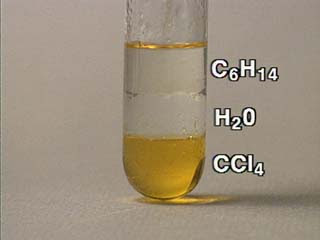
In this part of the lab, we want to see if hexane, ethanol, pentanol, methanol, butanol, and acetone mix with water.
~This is what it looks like if it does not mix with water. There is a split between the different solutions.
After we do this, We see if it mixes immediately. If it does not mix we have to put a stopper on the test tube, shake it, and then see if it mixes then.
-Hexane- Does not mix immediately, Does not mix after shaking.
-Ethanol- mixes immediately, It stays mixed after shaking.
-Pentanol- Does not mix immediately, Does mix after shaking.
-Methanol- Does not mix immediately, Does mix after shaking.
-Butanol- Does not mix immediately, Does mix after shaking.
-Acetone- mixes immediately, Stays mixed after shaking.
-Part two- Volatility and Surface Tension
In this part of the lab we want to see which solution spreads faster and which solution evaporates the fastest. What we do is we put a drop of each liquid on the lab table and see which one spreads more and which one evaporates faster. 7th being spreads out the least and evaporates the slowest.
Liquid Spreading rank Evaporating rank
-water 7 7
-hexane 1 2
-ethanol 5 4
-pentanol 6 3
-methanol 4 5
-butanol 3 6
-acetone 2 1
The liquids that spread out more are non polar and the liquids that spread out the least are polar because the atrraction is has on the solution gets the solution closer together and holds it together more. Also if something is more polar, then it will evaporate the slowest because sticks more together to the table. That is why hexane evaporates faster, it is because it is non polar and there is no attraction to it that holds it down and together.
The next scriber will be Mahak =]

Thursday, November 18, 2010

11/18/10

Announcements: Chem day tomorrow 11/19/10 in the lyceum
Quiz on Monday
Lab test on Tuesday
Homework: None

In the beginning of class we learned about polar and non-polar molecules. Polar molecules can not be split while non-polar can. If the molecule is bent it will always be polar. Just because it has polar bond does not mean it is a polar molecule.

The Lab: In the lab we put drops of water and hexane on a penny. The penny was able to hold more drops of water than hexane because it is a polar molecule. Polar molecules like to clump together because of the opposite charges within itself attract each other.


We also put drops of water and hexane in a watch glass and then put a thin glass tube (called a capillary tube) upright and covered the top of the tube so the liquids would go up the tube. The water went up further and stayed in the same spot when we tipped the tube back and forth. While the hexane didn't go up as far and would move around when tilted. Since the water molecule stayed in the same spot, the glass molecules are polar. This is because it attracted the water which is polar and did not attract the hexane because it it non-polar and likes attract likes.

In the last part of the lab we drew two lines on a watch glass. One of the lines was with a transparency marker and the other with a permanent marker. When we use the cotton swab with water on it the transparency line came off and the color leaked onto the swab. It also cleaned up all of the permanent line. Then we drew two more lines on a watch glass and put hexane on a different cotton swab. When we wiped the transparency line it did not come off and the line stayed on the watch glass. When we wiped the swab on the permanent line it came off. The ink in transparency marker is polar because the water(polar) was able to be wipe up while the hexane(non-polar) was not able to pick up the transparency line.

The next scriber will be Elizabeth.

Tuesday, November 16, 2010

11.16.10

ANNOUNCEMENTS: We took a quiz today, pick up pages 21-24 if you were not here, and I think that is it.


HOMEWORK: Page 24


Today we learned about different types of bonds that are related to electronegativity. Electronegativity as you may remember, describes an element's tendency to "hog" electrons (pull them closer to themselves than the other atom). We got a periodic table that has each element's electronegativity.


The three different bonds we learned were:


Purely covalent/non-polar: In this bond, neither atom has that much of a stronger pull than the other. The difference between the electronegativites of the two atoms will be 0.0-0.4


(*To find the electronegativity difference just subtract the smaller electronegativity from the larger one. EX: Carbon has an electroneg. of 2.5, Hydgrogen has an electroneg. of 2.1 so the difference is .4 This would be a non-polar covalent bond.)


Polar covalent: One atom has a slightly larger electroneg. causing it to have a stronger attraction to more electrons. Difference of electroneg. is 0.5-1.6


(EX: Hydrogen is 2.1, Oxygen is 3.5. The difference is 1.4 so it is polar covalent.)


In both of these, electrons are shared.


Ionic: In an ionic bond, one atom has a significantly larger attraction to the electrons than the other. In this case electrons are transferred. The range for this is 1.7 or greater.


(EX: Sodium is .9 and Flourine is 4.0 The difference is 3.1 so it is ionic)


We also learned how to identify atoms with a partial positive and a partial negative charge.


The atom with the greater electronegativity will have a partial negative charge because there are more electrons going towards it. And the partial positive atom has the smaller electronegativity because there are less electrons attracted to it.


Mr. Paek taught us the symbol that is used for this.


Disregard the second picture, he did not teach us that. The S looking thing is the symbol. If it's partial negative then a - sign will follow the symbol. And if its partial positive then it will be a + sign. In this image, hydrogen has an electronegativity of 2.1 and flourine has one of 4.0 Because flourine's electroneg. is greater, more electrons are attracted to it so it has a partial negative charge.
That's all folks!
Oh and the next scriber shall be Jillian (:

Monday, November 15, 2010

Monday, November15, 2010

11/15/2010
Announcements:
-Test will be on Wednesday after thanksgiving break.
-Web assigns are due Tuesday after thanksgiving break.
-Mr. Paek said he will not return our quizzes, but we get to retake one and drop the lowest.
-Mr. Paek also said that if there is anyone who doesn't get the lewis structure, they should go see him ASAP because it's important. The lewis structure is a key concept and you have to completely get it in order to understand upcoming lessons.
Homework:
-Finish up to page 19.
- Make sure you finish the 2 practice sheets we got on Thursday that go along with the chem think.(they might be collected tomorrow.)
In Class:
Well first Mr. Paek introduced to us the concept of VSEPR. He said that he will use this term a lot and he wants us to understand it. here is what each letter stand for:
-V= Valence
-S= Shell
-E= Electron
-P= Pair
-R= Repulsion
-This theory is used to prove that electron want to repel as far away from each other as possible.
-there are 5 types of molecular shapes: linear, bent, trigonal planar, trigonal pyramid, tetrahedral.
*Linear and bent are usually associated with 2 electrons and are are usually 2 dimensioned . (example by Mr. paek: If Mac and Kevin were to have a fight where would they go in the room to be as far away from each other as possible? the answer was in the corners of the room.)
*Trigonal planar, trigonal pyramid, and tetrahedral are associated with 3 electrons and are usually 3 dimensioned.(example by Mr. paek: if Max, Kevin, and Jimmy were to fight over kinga, where would they want to be in the room in order to be as far away from each other as possible? the answer was 2 would be in each corner and one would be in the middle)
- those were examples to help us visualize and help us understand what molecular shapes look like.
-Other key things to remember is that the lone pairs are key because they push everything down and change shape. And for shape you don't need dots unlike lewis structure.
- The picture at the right is page 16: I am going to go over the first one, so you guys get an idea on what we did today.
CS2
Needs: 24; Has:16;Shares:8; Bonds:4 .

I am sure we all know how to draw the lewis structure for this one ( see Mr. Paek if you don't), well the molecular shape is the same as the lewis structure but without the dots. and the name of the shape is linear.
The next scriber will be Andrea.

Sunday, November 14, 2010

11-10-10 11-14-10

THURSDAY
Announcements: total review. don't forget you can drop your lowest quiz that we take.

Homework: none!!

Class: On Thursday we had a total review day. we reviewed all lewis structures, also went over homework pages 11,12,13. Then we took a quiz. after the quiz, we finished all the pages in our notebook.(up to 15) we worked on the pages all through class. most people had 10 minutes to spare at the end.

FRIDAY
Announcements:You can drop one quiz.

Homework: Finish chem think(if not finished in class) and finish the 2 practice pages.

Class: In class on Friday we went to the computer lab to work on chem thinks. The name of the chem think is "Molecular Shapes". This can be found under Covalent Bonding. It started of by explaining what VSEPR stands for. VSEPR stands for Valence Shell Electron Pair Repulsion. When you get atoms in a molecule, the bonds in the electrons repel each other. when more are added the atoms repel so they can get the furthest away from the other atoms.

While working on this chem think we had to answer a work sheet. A covalent bond is electrons being shared by two atoms. Electrons are found in the middle of the two atoms when in a covalent bond. When two atoms are bonded to a central atom the angle between them is a 180 degrees. when there are 3 is is 120 degrees. for four atoms bonded to a central atom it is 109.5 degrees.

While working with molecular shapes there are (as you can tell in the title) many different shapes. when there is just two to a bond the shape is linear. when it is in two dimensional with three atoms it is called trigonal planar. If their is a lone pair of electrons, it doesn't affect the atom but it does make the atom bent. the shape is called bent. when their is three atoms and it is three dimensional the shape is called a tetrahedral. again with lone electrons and three atoms the shape is called a trigonal pyramid.

after we finished the tutorial we moved on to the question set where you have to answer ten correct with getting 2 or less wrong. if you get three wrong you have to start over again.

Next scriber will be...... YASSINE!! (you know why)

Tuesday, November 9, 2010

11.9.2010

Announcements:
-During Unit 5, we will take 6 quizzes and be able to drop the lowest score.
-We took quiz #1 today.
-We will take quiz #2 tomorrow.
-We received pages 9-15 today.

Homework: Finish pages 9-15

Class: Today, we started off by doing a quick question and answer about what material was going to be on the quiz. After this, we then took our first quiz of unit 5. Once everyone had finished the quiz, Mr. Paek showed us what the answers were and went over them with us. The quiz was out of 8 total points with each question being worth half of a point.

We then started going over pages 9-15.
Page 9: This first page was Guidelines for Drawing Lewis Structures. What you first must do when you are drawing the Lewis Structures is to count the total number of valence electrons in the compound. If you are finding the structure of an ion, remember to add electrons for a negative charge and subtract electrons for a positive charge. Secondly, you should predict the arrangement of the atoms in the molecule, drawing a line to represent a single bond between each pair of bonded electrons. Thirdly, you should find the number of valence electrons left over after forming single bonds. The fourth step is to place electrons around the outside atoms until each is surrounded by eight electrons (the octet rule). H is the only element which does not follow the octet rule. The final step is to place any left over electrons around the central atom.

Page 10: Lewis Structures 1
-Ex: What is the Lewis Structure for CH4
Ans: What you would do would be to find out the needed electrons, how many electrons the compound has, how many electrons are shared, and how many bonds there are. In this instance there are 8 electrons needed for C. There are also 8 electrons needed for H4 because H needs 2 electrons and since there are 4 of the H electrons that makes 8. If you add 8+8 you will get 16. Therefore this compound needs 16 atoms. Next, is the amount of electrons they have. H4 has 4 electrons combined, and C has 4 electrons. That gives you 8 more electrons for 16. Therefore, they have 8 electrons shared. Then, you divided the shared electrons by 2 and you get the amount of chemical bonds. Then you need the formula. For this atom the formula would be H
/
H-C -H
/
H

Page 11: This is just a page of practice problems
Ex: H2O
Ans: There are 12 electrons needed, there are 8 electrons between H2 and O. There are 4 electrons shared. There are 2 bonds. Based upon this information, the formula would look like this ..
H-O-H
..

Page 12: Lewis Structures 2
Ex: Which elements are allowed to break the octet rule?
Ans: Elements allowed to break the octet rule if they do not have a full shell of valence electrons.
Ex #2: Does element A violate the octet rule?
/ / /
A
/ / /
Ans: Yes because each of those lines has two electrons in it and A would have more than eight electrons with those connected to it.


Page 13: More practice formula pages
Ex: What is the Lewis Structure for HCN?
Ans: There are 18 electrons needed, they have 10 electrons combined, therefore there are 8 electrons shared which means that there are 4 bonds. The formula would look like this:
H=C=N

Page 14: Lewis Structure 3
Ex: Draw the Lewis structures for carbon tetra-fluoride.
Ans: First you have to realize that that is CF4. Once you have done this, you can solve. Together they need 40 electrons. They have 20 electrons, this means that they share 20 electrons which comes out to 10 bonds. The formula would look like this:
.. ..
F F
/ /
C
/ /
F F
.. ..


Page 15: This is the final page of the journal and it is half of a page of practice problems.
Ex: Name the group of elements that X would belong to.
X .
Ans: X would belong to the Alkali metals group because it only has one valence electron and alkali metals only have one valence electron.

NEXT SCRIBER: JIMMY

Monday, November 8, 2010

11.8.10

Announcements:
-We picked up and taped in our calender for Unit 5
-As well as sheets 2-8
-This unit we will have 6 quizzes (and drop the lowest score if desired)
-Our first quiz will be tomorrow (Tuesday October 9, 2010)

Homework: Finish pages 2-8 (excluding page 3)

We started off by reviewing a little bit of covalent bonding (talking about where there is the least potential energy (when they are sharing electrons at a comfortable distance) and the most potential energy (when the atoms become too close so the protons of each nuclei repel each other)).
We took the rest of class to finish pages 2-8
Page 2: Questions about potential energy
-Ex: Does the potential energy increase/decrease as the atoms move closer?
Ans: Decrease as the atoms are sharing the electrons thus making their pull on them less.

Page 4: Naming Covalent Bonds Practice 1
-Ex: What is the name for the bond of CO?
Ans: Carbon Monoxide. Because there is only one carbon atom and it is the first atom named, the mono- is dropped leaving just carbon but because the second atom is oxygen and there is only one it uses the prefix mono and because the second atom should end in -ide, it becomes oxide creating Carbon Monoxide.

Page 5: Naming Covalent Bonds (2)
-Ex: CO. Ionic or Covalent?
Ans: Covalent (because it is between two non-metals) Carbon Monoxide

Page 6: Naming Covalent Bonds (3)
-Ex: Nitrogen Dioxide. Ionic or Covalent?
Ans: . NO2 (Because there is only one nitrogen it is simply nitrogen, and because there are two oxygens the prefix di- (indicating two) is placed in front of oxygen and the suffix -ide is placed at the end) and it is covalent (two non-metals)

Page 7: Naming Covalent Practice (3)
-Ex: PCl3
Ans: Phosphorous Trichloride (one phosphorous is simply phosphorous and because there are three Chlorines the prefix tri- (indicating three) is added as well as the suffix -ide)

Page 8: Naming Covalent Compounds (4)
-Ex: SiO2
Ans: Silicon Dioxide (again, one silicon is just silicon and because there are two oxygens a di- is placed in front and you get Silicon Dioxide)